








































 1st Place

 2nd Place

 3rd Place


7 Best Forex Day Trading Strategies
On this page
- What is Forex day trading?
- Which strategies are best for beginners?
- Forex Day Trading Strategies Compared
- Forex Day Trading Strategies - A Key Point Quick Overview
- 1. Overview
- 2. What is Day Trading?
- 3. Why is Day Trading so Popular?
- 4. Why are Forex Trading strategies important?
- 5. How to develop a Forex Trading Strategy
- 6. Advantages and Disadvantages
- 7. The Best Forex Day Trading Strategies
- Top 10 Best Forex Brokers Globally – A Direct Comparison
- Pros and Cons
- In Conclusion
- You might also like:
- Frequently Asked Questions
We have outlined the best Forex day trading strategies designed to help traders capture short-term market movements.
These approaches focus on timing, risk control, and technical analysis, enabling both beginners and experienced traders to identify opportunities quickly, manage trades effectively, and pursue consistent daily profits with greater confidence overall.
What is Forex day trading?
Forex day trading involves opening and closing currency positions within a single trading day to profit from short-term price fluctuations. Traders avoid overnight fees and market gaps by ensuring all trades are settled before the session ends.


| Rank | Broker | Regulators | Broker Review | Min Deposit | Max Leverage | Visit Broker |
|---|---|---|---|---|---|---|
| 🥇 |  | FSCA, FSC, FSA | Read Review | $50 | 1:3000 | 
|
| 🥈 |  | ASIC, FSA, CBI, BVI, FSCA, FRSA, CySEC, ISA, JFSA | Read Review | $100 | 1:400 |
|
| 🥉 |  | FSA, CySEC, FSCA, FSC | Read Review | $10 | 1:3000 |
|
| 4 |  | FCA, CMA, FSC, SCA | Read Review | $30 | 1:3000 |
|
| 5 |  | FSCA, FCA, FSA, CMA, St. Vincent & the Grenadine | Read Review | $0 | 1:2000 |
|
| 6 |  | Globally regulated with multiple licences from respected financial regulators. | Read Review | $10 | 1:2000 |
|
| 7 |  | FSC, CySEC, ASIC | Read Review | $5 | 1:3000 |
|
| 8 |  | ASIC, BaFin, CMA, CySEC, DFSA, FCA, SCB | Read Review | $10 | 1:30 for retail EEA/UK |
|
| 9 |  | FSC | Read Review | $10 | 1:200 |
|
| 10 |  | ASIC, CySEC, FSCA, FSA | Read Review | $100 | 1:500 |
|


Which strategies are best for beginners?
Beginners should focus on trend following, which involves trading in the direction of market momentum. Swing trading and price action using support and resistance levels are also effective, as they simplify decision-making without complex indicators.
Forex Day Trading Strategies Compared
| Strategy | Works Best When | Typical Holding Period | Main Advantage | Main Risk |
| Trend Pullback | Market is trending | Minutes to hours | Trades with broader direction | Trend may reverse |
| Breakout Trading | Price leaves consolidation | Minutes to hours | Can capture strong momentum | False breakouts |
| Range Trading | Market is sideways | Minutes to hours | Clear support and resistance | Range can suddenly break |
| Momentum Trading | Price is moving strongly | Minutes to hours | Follows strong moves | Late entries |
| Scalping | High liquidity, small moves | Seconds to minutes | Many short-term opportunities | Costs and fast decisions |
| Moving Average Strategy | Market has directional bias | Minutes to hours | Simple trend filtering | Performs poorly in chop |
| News Trading | Major economic event | Seconds to hours | Strong volatility | Slippage and wider spreads |
Forex Day Trading Strategies - A Key Point Quick Overview
- Overview
- What is Day Trading?
- Why is Day Trading so Popular?
- Why are Forex Trading Strategies Important?
- How to Develop a Forex Trading Strategy
- Advantages and Disadvantages
- The Best Forex Day Trading Strategies
1. Overview
Forex day trading is about catching shorter-term moves in currency pairs, with most positions opened and closed before the trading day ends.
And the market behind those trades is huge.
According to the Bank for International Settlements, average daily OTC forex turnover reached $9.6 trillion in April 2025, up from $7.5 trillion three years earlier. The US dollar was still involved in 89% of all FX trades.
That amount of activity means major currency pairs can be extremely liquid. But high liquidity does not make day trading easy.
A short-term trader still has to deal with spreads, commissions, slippage, and leverage. Then there are the fast moves around economic data, central-bank announcements, and unexpected news. Sometimes the market simply does the opposite of what you expected. That is where having a strategy matters.
You should know what you are waiting for before the price starts moving. Entry conditions, stop-loss, position size, and exit rules should already be clear before the trade is placed.
2. What is Day Trading?
Day trading is a well-established practice in the trading community, involving the buying and selling of forex pairs within a single day—often within minutes or hours. The goal is to make multiple small profits, typically just a few pips, that accumulate into significant gains over time.
Unlike long-term investors, day traders focus on short-term trades, staying active at their terminals to seize opportunities as they arise. They utilize advanced charting technologies and technical indicators, often basing decisions on current events and market trends.
Prepared for quick changes, day traders capitalize on events like product launches or earnings releases. They tend to be well-educated, well-funded, and employ high leverage and various short-term strategies to adapt to different market conditions.
| Aspect | Explanation |
| Definition | Day trading is a trading style where traders buy and sell financial instruments within the same day, closing all positions before the market ends. |
| Main Goal | To profit from small price movements that happen throughout the day. |
| Holding Time | Trades can last from a few seconds to several hours, but never overnight. |
| Markets Used | Commonly used in Forex, stocks, indices, and commodities markets. |
| Tools Needed | Traders rely on charts, technical indicators, fast execution platforms, and real time news. |
| Risk Level | Considered high risk because prices can change quickly in short timeframes. |
| Skills Required | Requires discipline, quick decision-making, strong risk management, and knowledge of market analysis. |
| Typical Strategies | Includes scalping, breakout trading, momentum trading, and range trading. |
| Best For | Traders who can actively monitor markets and make fast trading decisions. |
| Key Rule | Positions must be closed before the trading day ends to avoid overnight risk. |
What Does a Good Day Trading Strategy Include?
At minimum, a strategy should answer:
- Which currency pairs will I trade?
- Which session will I trade?
- What market condition am I looking for?
- What triggers an entry?
- Where does the trade become invalid?
- Where will I take profit?
- How will I determine position size?
- When should I avoid trading?
The last question is often overlooked.
A strategy doesn't only tell you when to trade. It should also tell you when not to trade.
Frequently Asked Questions
Is day trading suitable for beginners?
Yes, beginners can try day trading, but it requires learning basic market concepts, practicing on demo accounts, and using strong risk management to avoid large losses early on.
How much time do you need for day trading?
Day trading usually requires active monitoring of the markets for several hours a day, since trades are opened and closed within the same trading session.

3. Why is Day Trading so Popular?
Day trading has gained popularity for several reasons. Traders can quickly cash out their positions when selling, making liquidity easy to achieve. It typically requires less capital to start compared to other investment options, and day traders manage their trades, often realizing returns of 20% to 30%.
Additionally, the forex market is accessible and fair to all participants.
| Reason | Explanation |
| Quick Profit Potential | Traders can make profits within hours instead of waiting days, weeks, or months. |
| No Overnight Risk | All trades are closed the same day, so traders avoid unexpected price changes while markets are closed. |
| High Market Activity | Markets like Forex move constantly, creating many daily trading opportunities. |
| Low Starting Capital | Many brokers allow traders to start with relatively small amounts of money. |
| Flexibility | Traders can choose when and how long they want to trade during the day. |
| Leverage Availability | Traders can control larger positions using smaller amounts of capital. |
| Technology Access | Modern trading apps and platforms make it easy to trade from anywhere. |
| Fast Learning Curve | Traders get quick feedback on decisions, helping them improve faster. |
| Multiple Daily Opportunities | Unlike long-term investing, traders can take many trades in one day. |
| Independence | Day trading allows people to work independently without a traditional job structure. |
Frequently Asked Questions
Why do many traders prefer day trading over long-term investing?
Many traders like day trading because it offers quick results, frequent opportunities, and the ability to profit from short-term market movements without holding positions for long periods.
Does day trading require a lot of money to start?
Not necessarily. Many brokers allow traders to start with small deposits, and leverage can help control larger trades, which makes day trading accessible to more people.

4. Why are Forex Trading strategies important?
While many trading strategies exist, traders must select and commit to one that aligns with their goals, risk tolerance, and personality. A trader’s performance depends not only on the strategy chosen but also on how consistently and accurately it is executed. Even the most effective system fails without discipline, patience, and structured risk management.
Well-defined forex day trading strategies provide a measurable edge by establishing clear entry and exit rules, position sizing guidelines, and risk controls. This structured approach allows traders to act proactively rather than emotionally. Ultimately, strong strategies aim to generate consistent profits through disciplined buying and selling decisions while protecting capital from impulsive, unplanned trades.
| Reason | Explanation |
| Provides Clear Direction | A strategy gives traders a structured plan on when to enter and exit trades instead of guessing. |
| Reduces Emotional Decisions | Helps traders avoid impulsive actions driven by fear, greed, or panic. |
| Improves Risk Management | Strategies include rules for stop-losses and position sizing to protect trading capital. |
| Creates Consistency | Following a strategy helps traders trade in a disciplined and repeatable way. |
| Saves Time | Traders know exactly what to look for, making decision making faster and more efficient. |
| Increases Confidence | Having a tested plan makes traders feel more secure in their trading choices. |
| Helps Measure Performance | Strategies allow traders to track results and improve over time. |
| Controls Losses | A solid strategy limits unnecessary risks and prevents large unexpected losses. |
| Supports Long-Term Success | Consistent strategy use increases the chances of sustainable trading results. |
| Adapts to Market Conditions | Different strategies help traders handle trending, ranging, or volatile markets. |
Frequently Asked Questions
Why do traders need a Forex trading strategy?
Traders need a Forex strategy to guide their decisions, manage risk, and avoid emotional trading. It helps them know when to enter, exit, and manage trades more effectively.
Can you trade Forex successfully without a strategy?
While it’s possible in the short term, trading without a strategy usually leads to inconsistent results, higher risks, and emotional decisions, making long-term success very difficult.

5. How to develop a Forex Trading Strategy
Start by summarizing the purpose of your day trading strategy and the techniques you'll use. Research different methods to find what suits your style. This overview helps clarify your approach and serves as a reference.
Create Recognition Criteria
Define the price action concepts for your strategy, outlining the conditions for bull, bear, and neutral markets. If using indicators, specify criteria like price relative to moving averages or ADX levels to identify market conditions.
Define Trading Signals
Trading signals are triggers to buy or sell. Use price action techniques, technical indicators, or fundamental analysis to generate these signals. Focus on developing a strategy that suits your style and is easy to remember.
Exit Scenarios
Plan your exits before trading. Define your stop-loss and take-profit levels based on risk management principles, aiming for a risk/reward ratio of at least 1:2 or 1:3 to ensure potential gains outweigh losses.
Backtest and Improve
Backtest your strategy using at least three years of historical data across different currency pairs. Analyze results to identify losing trades and refine your approach. Learn from both wins and losses to enhance your strategy.
6. Advantages and Disadvantages
One of the main advantages of day trading is that it allows traders to concentrate on short-term price movements without deeply analyzing long-term economic fundamentals or macroeconomic trends. This approach creates frequent trading opportunities throughout the day and offers meaningful profit potential when traders apply a well-tested strategy and disciplined execution.
Day traders also close all positions before the market session ends, which helps them avoid overnight financing fees, unexpected gaps, and after-hours volatility. However, day trading demands constant attention, quick decision-making, and strong emotional control. Rapid price fluctuations can make the process stressful and mentally exhausting. The strategy carries substantial risk, and many beginners face losses before developing consistency.
With dedication, structured learning, and strict risk management, traders can gradually build the skills needed to manage these challenges and potentially succeed in the competitive world of day trading.
7. The Best Forex Day Trading Strategies
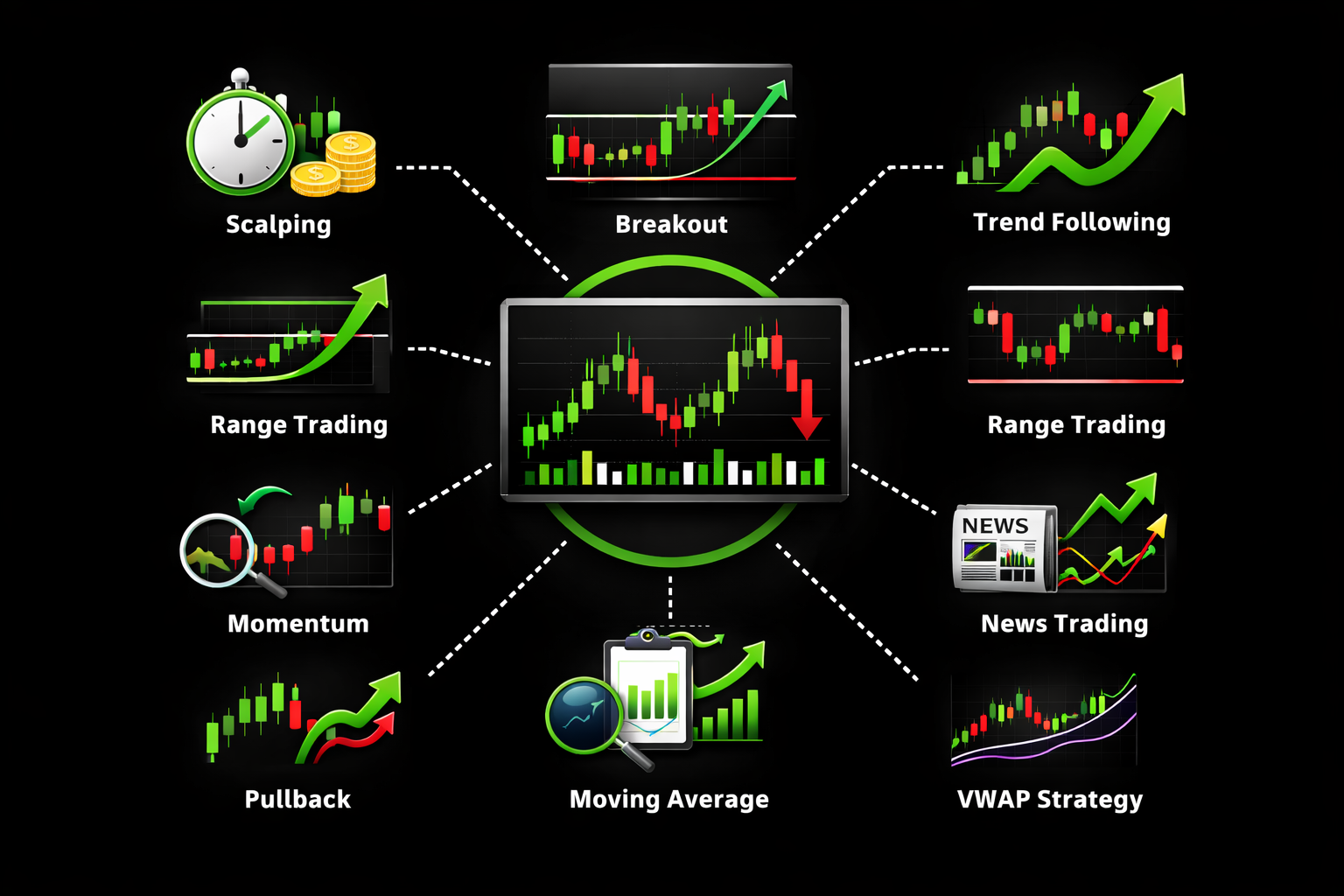
Scalping remains one of the most widely used day trading strategies because it focuses on capturing very small price movements throughout the trading session. Traders execute a high volume of trades, aiming to accumulate consistent gains from minor fluctuations. They enter positions near short-term lows and exit quickly once the trade turns profitable, while strictly applying stop-loss and take-profit levels to control risk exposure and protect capital.
Breakout trading takes a different approach. Traders monitor key support and resistance levels and enter a long position when the price breaks convincingly above resistance, signaling potential upward momentum. They open short positions when the price falls below support, anticipating further downside movement. This strategy relies heavily on timing, volume confirmation, and disciplined risk management.
News trading focuses on capitalizing on sharp market reactions to economic releases, geopolitical events, or central bank announcements. Traders buy when news supports bullish sentiment and sell or short-sell when developments trigger negative expectations. However, sudden volatility, slippage, and widened spreads make this strategy particularly risky and suitable for experienced traders.
Trend following emphasizes identifying and aligning with the prevailing market direction. Traders buy during sustained upward trends and sell short when prices peak and begin to reverse. By understanding how these strategies work and when to apply them, traders can navigate the fast-paced nature of day trading with greater structure and confidence.
| Strategy | How It Works | Best For |
| Scalping | Traders open and close many trades within minutes to capture very small price movements. | Traders who can monitor charts constantly and act quickly. |
| Breakout Trading | Traders enter a trade when price moves above resistance or below support levels. | Beginners looking for clear entry signals. |
| Trend Following | Traders identify the market direction and trade in the same direction as the trend. | Those who prefer simpler, low-stress strategies. |
| Range Trading | Traders buy at support levels and sell at resistance when markets move sideways. | Calm markets with no strong trend. |
| Momentum Trading | Traders enter trades when price is moving strongly in one direction with high volume. | Fast-moving market conditions. |
| News Trading | Traders take advantage of big price moves caused by economic news releases. | Experienced traders comfortable with volatility. |
| Pullback Trading | Traders wait for temporary price retracements before entering in the trend direction. | Traders who want better entry prices. |
| Moving Average Strategy | Uses moving averages to identify entry points and trend direction. | Beginners learning technical indicators. |
| Price Action Trading | Traders rely on chart patterns and candlestick movements without indicators. | Traders who prefer clean charts. |
| VWAP Strategy | Uses the Volume Weighted Average Price to find fair value and entry points. | Intraday traders seeking precise timing. |
Frequently Asked Questions
Which Forex day trading strategy is best for beginners?
Trend following and breakout strategies are often best for beginners because they provide clear signals and are easier to understand than fast-paced strategies like scalping.
Can I use more than one day trading strategy at a time?
Yes, many traders combine strategies, such as trend following with pullback entries, but it’s important to test them carefully and maintain strong risk management.
Top 10 Best Forex Brokers Globally – A Direct Comparison
| Broker | Feature | Trade Now | Broker Review |
| AvaTrade | Extensive Platform Variety Zero Commission Multi-Jurisdiction Regulation | Click Here | Click Here |
| iUX | Ultra-Fast Execution Low Minimum Deposit Swap-Free Trading | Click Here | Click Here |
| JustMarkets | Diverse Account Types Wide Instrument Range User-Centric Features | Click Here | Click Here |
| MultiBank Group | Top-Tier Regulation Raw Spreads Multiple Platforms | Click Here | Click Here |
| HFM | Security and Regulation High Leverage and Low Spreads Excellent Execution | Click Here | Click Here |
| Exness | Instant Withdrawals Superior Trading Conditions Stop Out Protection | Click Here | Click Here |
| FBS | Accessible Trading Rapid Execution Low Costs | Click Here | Click Here |
| Pepperstone | Versatile Trading Platforms Broad Regulatory Coverage Low-Cost "Razor" Account | Click Here | Click Here |
| RoboForex | High Leverage Raw Spreads Zero Commission Accounts | Click Here | Click Here |
| FP Markets | Asset Diversity Low-Cost Trading Comprehensive Platform Selection | Click Here | Click Here |
Pros and Cons
| Pros | Cons |
| Positions are generally closed within the day | Requires regular market attention |
| Frequent potential setups | Can encourage overtrading |
| Faster feedback than long-term strategies | Trading costs can accumulate quickly |
| Strategies can be clearly tested | Short-term markets contain considerable noise |
| Major FX pairs can be highly liquid | Leverage can magnify losses |
| Different strategies suit different conditions | Fast decisions can create emotional pressure |
| No deliberate overnight holding | News can cause slippage and sudden volatility |

In Conclusion
Day trading offers a range of strategies that suit different trading styles, risk appetites, and levels of experience. Scalping focuses on capturing small price movements within minutes, while breakout trading targets strong momentum when price moves beyond key levels. News trading takes advantage of volatility following economic announcements, and trend following aims to ride sustained market direction. Each strategy presents distinct opportunities, but each also carries measurable risk.
Although these approaches can generate meaningful short-term profits, they demand discipline, rapid decision-making, emotional control, and a solid understanding of market structure, liquidity, and volatility. Successful day traders commit to continuous learning, refine their strategies through experience, adapt quickly to shifting market conditions, and apply strict risk management to protect capital over the long term.
You might also like:
What is Forex Trading – A Beginner's Guide
Best Forex Strategies for Consistent Profits
Frequently Asked Questions
How much time do I need to trade each day?
The time required depends on your strategy. Day traders may spend 2 to 4 hours during peak market sessions, while swing traders only need 30 minutes daily to review charts and manage their open positions.
Are Forex day trading strategies profitable?
Forex day trading strategies can be highly profitable for the top 1% of disciplined professionals. However, statistics show that nearly 90% of retail traders lose money due to high leverage, lack of education, and emotional decision-making.
Is scalping suitable for beginners?
Scalping is rarely suitable for beginners. It requires split-second execution, intense focus, and advanced technical knowledge. The high frequency of trades often leads to mounting commission costs and rapid account depletion for those without a legit strategy.
What tools do I need for Forex day trading?
To trade effectively, you need a reliable platform (MT4, MT5, or TradingView), a legit broker, and an economic calendar (like Forex Factory). Essential analysis tools include a trading journal and a pip calculator for risk management.
How do I manage risk with day trading strategies?
Manage risk by using a stop-loss on every trade to limit potential losses. Never risk more than 1% to 2% of your balance per position and use a pip calculator for precise sizing.
Can I practice day trading without real money?
Yes! You can use a demo account to practice day trading in real-time market conditions using virtual funds. It is a legit way to master platforms and strategies without any financial risk.
How do I choose the right strategy for me?
Choose based on your personality and schedule. If you are patient, try swing trading. If you crave action and have time, day trading or scalping might fit. Always backtest a legit strategy before risking capital.
Can news events affect day trading strategies?
Absolutely. News acts as a catalyst, causing sharp volatility, widened spreads, and "slippage." High-impact events like NFP or interest rate decisions can break technical patterns, forcing day traders to either sit out or adapt their strategies.