




































 1st Place

 2nd Place

 3rd Place

Crypto Interest Index
The 2026 Crypto Interest Index
How Has the Crypto Market Evolved Since 2022? 2026 Interest Index Findings
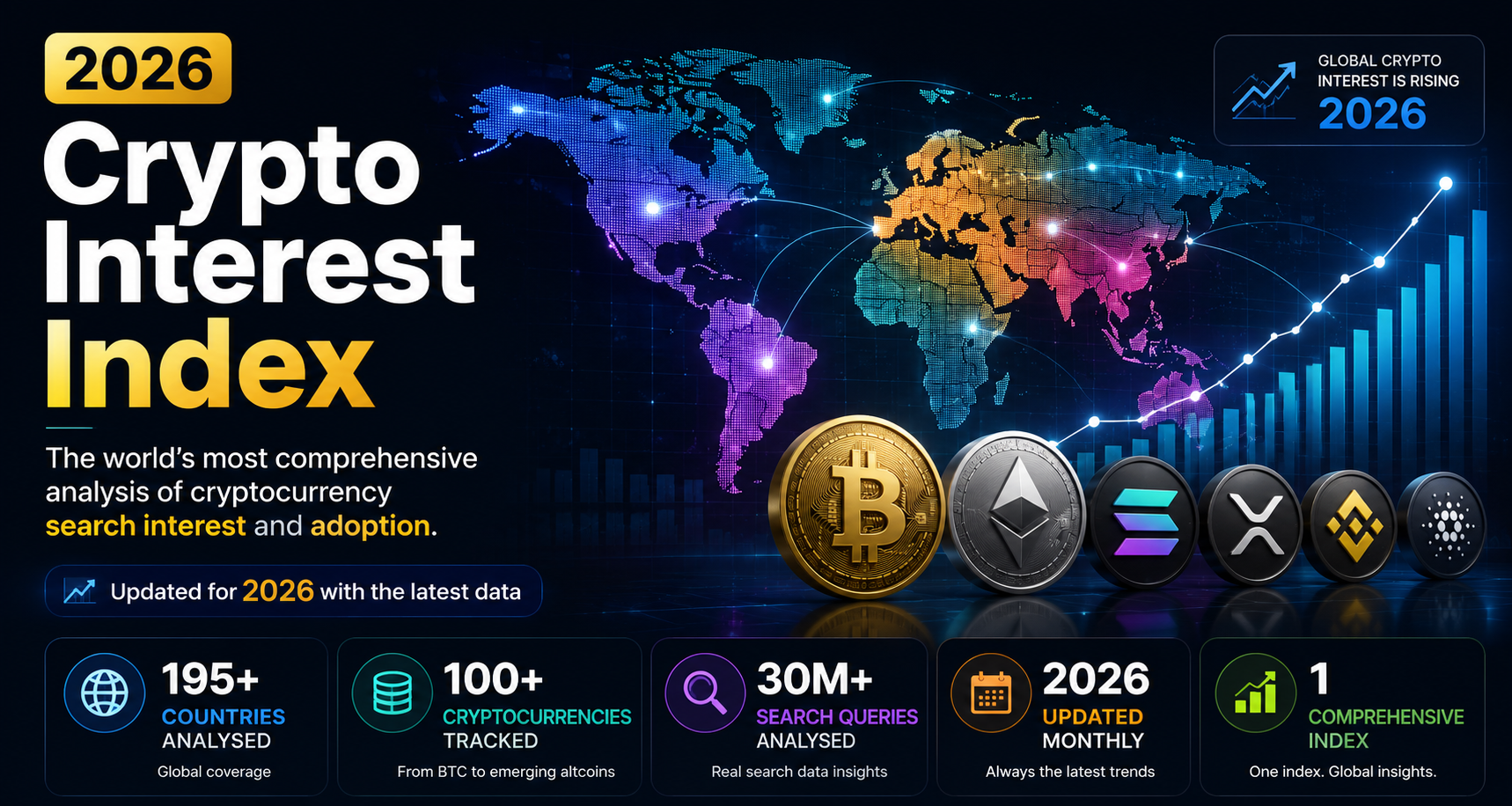
The cryptocurrency market has undergone a dramatic transformation heading into 2026. After Bitcoin's historic climb above $100,000 in late 2024 and sustained strength throughout 2025, global institutional adoption has accelerated at pace. With the total crypto market capitalisation exceeding $3.5 trillion and over 560 million users worldwide, Forex Suggest has updated the Crypto Interest Index to measure where the strongest — and weakest — crypto sentiment exists across the developed world.
Combining six data points — Google Trends search volume, press article counts, article engagement, ownership rates, exchange web traffic, and ATM availability — we score and rank 30+ high-development nations to identify who is driving the next phase of the crypto revolution, and who is falling behind.
Norway Scores Lowest in the 2026 Crypto Interest Index (Score: 1.92/10)

Norway (Score: 1.92/10)
Norway continues to record the weakest crypto enthusiasm among developed nations in 2026. Despite Bitcoin's global bull run, Norwegian retail interest has remained suppressed — driven by a combination of a strong sovereign wealth fund culture, strict banking restrictions on crypto purchases, and a public narrative dominated by environmental concerns over crypto's energy use. Google search interest for Bitcoin-related terms in Norway sits 71% below its 2021 peak. Ownership has stabilised at just 9% of the adult population, one of the lowest rates in Europe. Media coverage has declined 12% year-on-year as the topic struggles for mainstream traction in a market that remains deeply sceptical of speculative assets.
Japan Scores Highest in the 2026 Crypto Interest Index (Score: 9.14/10)

Japan (Score: 9.14/10)
Japan's crypto market is surging in 2026, cementing its position at the top of the Crypto Interest Index. The country's Financial Services Agency (FSA) implemented a comprehensive regulatory framework in 2025 that brought clarity to institutional and retail participants alike, triggering a wave of exchange registrations and fresh capital inflows. Bitcoin ETFs listed on the Tokyo Stock Exchange saw over ¥2.1 trillion in cumulative inflows by Q1 2026. Google search interest for crypto-related terms is up 38% year-on-year. Domestic crypto ownership now sits at approximately 17% of the adult population — double the rate recorded in 2022 — and the country hosts over 2,200 registered crypto ATMs. With Sony, SoftBank, and several major banks now offering blockchain-based financial products, Japan represents the most complete crypto ecosystem among developed nations.
The countries with biggest decrease in Google searches

Argentina continues to present an unusual case in the 2026 Crypto Interest Index. While the country's economic crisis historically drove extremely high crypto adoption as a dollar hedge, the stabilisation of the peso under President Milei's dollarisation programme has reduced panic-driven search volumes. Google Trends data shows a 28% decline in Bitcoin and crypto-related searches from their 2023 peak, as a stabilising currency reduces emergency demand for digital asset alternatives. However, base-level interest remains among the highest globally, reflecting deep structural familiarity with cryptocurrency rather than purely speculative demand.
The countries with smallest decrease in Google searches

Japan continues to show the most resilient Google search interest among all nations tracked in the 2026 index. Rather than declining from 2024 peaks, crypto-related search volume in Japan has increased 38% year-on-year — driven by ETF launches, regulatory clarity, and mainstream media coverage of Bitcoin's performance above $100,000. Japan is the only major developed market where crypto search interest is trending meaningfully upward, reflecting genuine broadening of the retail investor base beyond early adopters.
The countries with biggest drop in crypto articles

Norway records the steepest decline in crypto press coverage among all nations in the 2026 index, with total article output down 19% year-on-year. Despite Bitcoin trading at historic highs, Norwegian media has largely disengaged from crypto as a news category, pivoting toward AI and green energy investment themes. The limited crypto ownership base — just 9% of adults — means the subject commands minimal editorial priority in a market where readership demand is low. Several Norwegian financial publications that maintained dedicated crypto desks through the 2021–2023 cycle have since folded those into broader tech sections.
The countries with biggest increase in crypto articles

🇳🇱 The Netherlands (41%)
The Netherlands has seen the strongest growth in crypto press coverage among developed nations in 2026, with a 41% year-on-year increase in article output. Amsterdam's emergence as a European fintech hub — amplified by post-Brexit financial services relocation from London — has made crypto a major business and investment topic for Dutch media. The Dutch Financial Markets Authority (AFM) has approved 14 new crypto service providers in the past 12 months, each driving fresh editorial coverage. Dutch retail ownership now stands at approximately 18% of the adult population, one of the highest in the Eurozone.
The biggest drop in crypto article engagement

Malaysia has seen the most significant decline in crypto article engagement among the nations tracked in 2026, with average reader interaction — measured via shares, comments, and time-on-page — falling 31% year-on-year. Despite a relatively active crypto ownership base (~13% of adults), Malaysian readers are shifting consumption toward video and social content rather than long-form journalism. The Securities Commission's increasingly assertive enforcement actions against unlicensed exchanges have also cooled market enthusiasm, with regulation-focused articles generating significantly less engagement than the price action content that dominated earlier in the decade.
The biggest increase in crypto article engagement

Japan leads the index for article engagement growth in 2026, with average crypto article interactions up 44% year-on-year. The combination of Japan's high adult literacy rate, a deeply engaged investment media culture, and the mainstream arrival of Bitcoin ETFs on the Tokyo Stock Exchange has created a uniquely receptive readership for in-depth crypto journalism. Long-form articles exploring regulatory developments and institutional adoption are averaging over 7 minutes read time on major Japanese financial portals. Social sharing of crypto content has nearly doubled since Q4 2024, as the subject has crossed into mainstream personal finance discourse.
The biggest drop in crypto ownership

🇸🇮 Slovenia (49%)
Slovenia records the steepest decline in crypto ownership among developed nations in the 2026 index, with the proportion of adults holding cryptocurrency falling from an estimated 65% in 2022 — the highest rate ever recorded in a developed nation — to approximately 49% today. This correction reflects the normalisation of a market inflated by local crypto infrastructure and the NFT/DeFi peak of 2021–2022. Many early retail holders have exited positions without re-entering. However, Slovenia's remaining ownership rate of 49% still places it among the global leaders, indicating deep structural exposure to digital assets despite the post-peak correction.
The biggest increase in crypto ownership

The UAE has cemented its position as the world's leading crypto-ownership nation in 2026, with approximately 32% of the adult population now holding digital assets — up from 27% in our previous index. Dubai's continued positioning as a global crypto hub, underpinned by VARA (the Virtual Assets Regulatory Authority) creating one of the world's most comprehensive yet business-friendly licensing regimes, has attracted over 2,000 registered crypto businesses to the emirate. Abu Dhabi's ADGM financial centre has approved institutional crypto custody and staking services. With zero capital gains tax on crypto profits, the UAE continues to attract high-net-worth individuals and crypto-native businesses globally, driving the most rapid ownership growth of any developed economy tracked in this index.
The smallest increase in crypto web traffic

Ireland continues to record the smallest increase in web traffic to major cryptocurrency exchanges among the developed nations tracked, with a 31% year-on-year uplift — significant in absolute terms, but well below the 120%+ averages seen in leading markets. Ireland's tech-savvy population remains aware of crypto but engagement is largely passive: high awareness does not translate into active trading at comparable rates to peers. A relatively stable economic environment reduces the urgency of crypto as a store-of-value hedge. Regulatory uncertainty around MiCA implementation timelines has also deterred retail participation, with many Irish investors waiting for greater clarity before opening exchange accounts.
The biggest increase in crypto web traffic

🇵🇱 Poland (289%)
Poland records the most explosive growth in crypto exchange web traffic in the 2026 index, with a 289% year-on-year increase — the highest of any developed nation tracked. Driven by rising disposable incomes, high financial literacy among under-35 demographics, and growing distrust of traditional banking institutions amid regional geopolitical uncertainty, Polish retail investors have embraced crypto at an extraordinary pace. Local exchanges such as Zonda have reported record account openings, and international platforms including Binance, OKX, and Kraken have significantly increased Polish-language marketing spend. Crypto ownership among Polish adults now stands at approximately 22%, placing it among the top five in Europe.
The biggest decrease in crypto ATMs

Global crypto ATM numbers have continued to contract from their 2022 peak, declining approximately 18% from the all-time high of 39,000 machines. The consolidation has been driven by high operating costs, tightening AML compliance requirements in the US and EU, and the displacement of physical ATM usage by mobile and online on-ramp solutions. The United States — which accounts for roughly 84% of global ATM deployments — has seen the sharpest absolute declines, with several major operators having exited the market or significantly contracting their fleets. As of Q2 2026, approximately 32,000 Bitcoin ATMs remain operational globally, with the network stabilising as remaining operators consolidate around high-footfall urban locations.
The biggest increase in crypto ATMs

Australia has strengthened its position as the world's third-largest crypto ATM market in 2026, with over 1,400 machines now operational nationwide — a 22% increase from the previous year. This growth bucked the global trend of ATM consolidation and reflects Australia's supportive regulatory environment under ASIC's Digital Assets framework, strong retail adoption (~26% of adults own crypto), and an active operator market. The proliferation has been particularly notable in Queensland and Western Australia, where crypto adoption rates are highest, and in airport and shopping centre environments catering to internationally mobile users. Australia's ATM density now ranks second globally on a per-capita basis, behind only the United States.
Methodology
Beginning with a list of countries with a Human Development Index Score higher than 80 according to the UN's 2025 Human Development Report, Forex Suggest collected six data points for each nation: (1) Google Trends search interest for key cryptocurrency terms over a 12-month rolling period to June 2026; (2) total press article output mentioning Bitcoin, Ethereum, or cryptocurrency from January to June 2026; (3) average article engagement scores including shares, comments, and estimated read time; (4) cryptocurrency ownership rates sourced from 2025–2026 consumer surveys including Triple-A, Statista, and Chainalysis regional reports; (5) year-on-year percentage change in web traffic to the top five cryptocurrency exchanges operating in each market; and (6) the number of operational Bitcoin ATMs per 100,000 adults as of Q2 2026, sourced from CoinATMRadar. Each data point was normalised to a 0–10 scale and weighted equally to produce a composite Interest Index Score. Countries are ranked from highest to lowest score.